
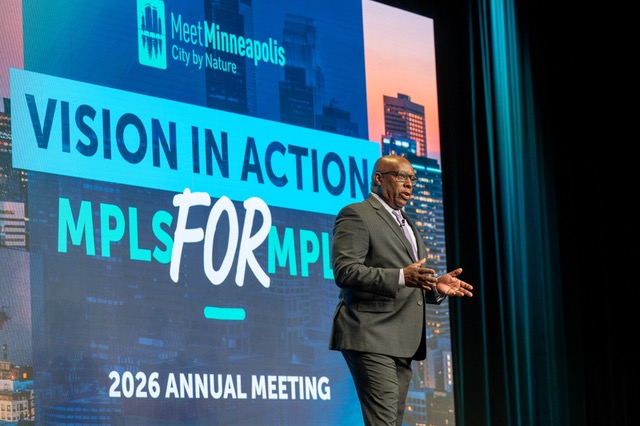
Amy Calvert, President and CEO of the Events Industry Council, recently sat down with Melvin Tennant, CAE, President and CEO of Meet Minneapolis, as part of EIC’s new Lessons in Leadership series. Their conversation explored what it means to lead a destination through complexity — a theme that has become increasingly urgent for business events professionals from all global regions and sectors as they navigate political tension, public safety concerns, community trust, shifting attendee expectations and the scarcity of resources.
For Tennant, who has led Meet Minneapolis since 2007, destination leadership has never been only about attracting visitors. “It is about stewardship — of a city’s reputation, its hospitality workforce, its civic identity and the communities that rely on business events to create opportunity,” he said.
That responsibility came into sharp focus in January, when Minneapolis became the centre of national attention following U.S. Immigration and Customs Enforcement activity in the city, including shootings involving federal immigration enforcement agents. In a public statement on 7 January, Minneapolis Mayor Jacob Frey said the presence of federal immigration enforcement agents was “causing chaos” and making the community less safe, while calling for ICE to leave the city and state immediately. The city also urged residents and visitors to demonstrate peacefully, emphasising the right to free expression while calling for calm, safety and lawful protest.
For Meet Minneapolis, the impact was both practical and deeply human. Business events continued, hotels and venues stayed engaged, and the city’s hospitality community worked to support visitors and one another. Yet Tennant was clear that the situation could not be viewed only through the lens of bookings, headlines or optics.
“In the midst of this sociopolitical issue, there’s a human side,” Tennant said, reflecting on how his team, board and local business owners were responding. He shared that the deep connections and existing relationships with civic leadership and the business community were central to Meet Minneapolis’ ability to navigate the situation, respond in a unified fashion and address concerns from many stakeholders, including the team in Minneapolis.
That human side is central to Tennant’s leadership. “Meet Minneapolis depends on the people and businesses that deliver the visitor experience: hotel teams, restaurant workers, transportation partners, small business owners, venue staff and community leaders,” he said. “When a city is under pressure, the role of a destination organisation is not to pretend the pressure does not exist. It is to stay close to partners, share accurate information, listen carefully and help maintain trust.”
“When a city is under pressure, the role of a destination organisation is not to pretend the pressure does not exist. It is to stay close to partners, share accurate information, listen carefully and help maintain trust.” — Melvin Tenant, CAE
Tennant described Meet Minneapolis as being closely aligned with the city’s public response while remaining focused on its responsibility to visitors and customers. The organisation met regularly with hotel leaders, stayed connected to business associations and maintained close communication with city officials and the Minneapolis Convention Center. He noted that the organisation’s sales team was also having one-on-one conversations with groups that had legitimate questions.
That kind of direct communication matters. For meeting organisers, destination confidence is built less through slogans and more through transparency, responsiveness and evidence that local partners are aligned.
“Authenticity and transparency and telling customers what is really happening is the key,” Tennant said.
For destination leaders, incidents like these raise difficult questions. How do you reassure meeting organisers without minimising real community pain? How do you protect the visitor economy while acknowledging that some residents and workers may feel unsafe or targeted? How do you communicate with confidence when the situation is changing day by day?
Tennant’s response offers an important lesson: lead with honesty, then connect that honesty to action.
“You cannot separate the visitor experience from the lived experience of the people who make that visit possible,” he said. “When our community is hurting, our first responsibility is to listen, support and stay connected.”
That leadership approach aligns closely with EIC’s Futures Landscape Study 2025, which identifies risk and security, mobility, advocacy, DEI, infrastructure and wellbeing as key forces shaping the future of business events. The study notes that destination management organisations will be increasingly evaluated by their ability to deliver meaningful, safe and inclusive experiences, particularly as organisers weigh accessibility, infrastructure, geopolitical conditions and community resilience in destination selection.
For Minneapolis, that means balancing immediate response with long-term destination strategy. Meet Minneapolis’ 10-year Destination Master Plan, developed through broad community and stakeholder input, includes priorities around destination competitiveness, downtown vibrancy, equity, reconciliation and a stronger convention centre district. At Meet Minneapolis’ 2026 Annual Meeting, programme themes included “Community Stewardship in Challenging Times,” “Driving Momentum Through Meetings & Events” and “Moving Forward, Together” — signals that the organisation is treating destination development, community trust and business events as connected priorities.
Tennant has also been candid about how quickly travel can become politicised. “We’re all vulnerable because it’s easy to politicise travel,” he said, noting that destination executives understand how external events can suddenly reshape perception and demand.
That vulnerability is not unique to Minneapolis. Around the world, destinations are being asked to respond to political tension, security concerns, climate disruption, mobility challenges and changing expectations around inclusion and belonging. The difference lies in how leaders respond.