New global research with Oxford Economics finds business events generated US$1.3 trillion in direct spending and supported US$1.8 trillion in total GDP worldwide in 2025
The Events Industry Council (EIC), the global voice of the business events industry on advocacy, research, professional recognition and standards, today released the 2026 Global Economic Significance of Business Events Study Executive Summary, produced in association with Oxford Economics.
The study provides a comprehensive view of the scale, scope and impact of business events worldwide, measuring activity across more than 180 countries.
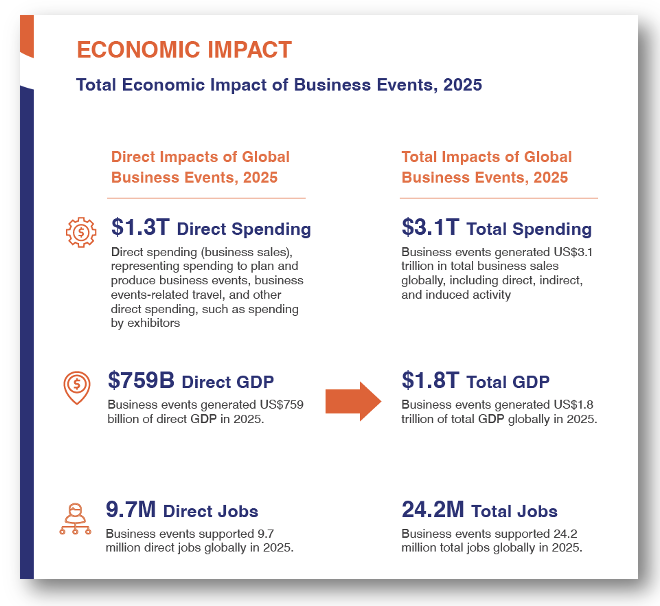
- In 2025, business events brought together 1.65 billion participants globally and generated US$1.3 trillion in direct spending, representing a 12.2% increase over 2019 levels.
- Including direct, indirect and induced impacts, the sector supported US$3.1 trillion in total business sales, US$1.8 trillion in total GDP and 24.2 million jobs worldwide.
“Business events are essential infrastructure for a connected, innovative and resilient global economy,” said Amy Calvert, President and CEO, Events Industry Council. “This study gives our industry credible, current data to demonstrate what we have long known: when people gather with purpose, they create economic value, strengthen communities, accelerate knowledge exchange and build the trust required to move ideas into action.”
The research, which is part of an ongoing rollout of advocacy tools and messaging, also shows that business events generated US$759 billion in direct GDP and supported 9.7 million direct jobs globally in 2025. Direct spending sales by business event activity averaged US$785 per participant, while trade shows directly supported US$180 billion in spending.
The report places the sector’s impact in broader economic context. In 2025, the business events sector directly generated $1.3 billion in direct sales, higher than many large global sectors, including manufacturing sectors, such air transport, telecommunications equipment, air transport, textiles and aerospace.
“This research is an important advocacy tool for every sector of our industry,” said Stephanie Harris, EIC Chair and President, The Incentive Research Foundation. “It helps destinations, venues, organisers, suppliers, associations and corporate leaders tell a stronger, more unified story about the role business events play in job creation, workforce development, innovation and long-term economic growth. The data reinforces that our sector is not discretionary — it is a driver of progress.”
The study also captures the continued recovery and future outlook of the global business events sector. By the fourth quarter of 2025, EIC’s Global Business Events Barometer showed RFP activity at 102% of 2019 levels and hotel group room nights at 97% of 2019 levels, indicating that global business events activity has recovered near pre-pandemic levels. Oxford Economics forecasts that direct spending attributable to business events will reach US$1.6 trillion by 2028, with direct employment reaching 10.4 million jobs.
“Business events have demonstrated remarkable resilience and continued relevance in a complex global environment,” said Adam Sacks, President of Tourism Economics for Oxford Economics. “The findings show not only the magnitude of direct spending and employment, but also the broader economic ripple effects created through supply chains, wages and local communities. The sector’s catalytic value — including business development, innovation, research collaboration and knowledge transfer — further underscores why business events matter to economies and societies around the world.”
The study defines business events as gatherings of 10 or more participants for a minimum of four hours in a contracted venue, excluding social, formal educational and recreational activities. The research process included primary research from a global survey of more than 1,600 event organisers, venues, destination marketing organisations, suppliers and other industry participants, as well as analysis of country-level studies, third-party industry data, EIC Global Business Events Barometer data and Oxford Economics’ global economic and business travel forecasts.
The report also highlights the catalytic effects of business events — the broader outcomes that occur when people gather. These include new business opportunities, customer leads, partnerships, professional development, knowledge transfer, research and development, innovation, health and technical advances, human and organisational capital, and productivity gains.
Oxford Economics forecasts that direct spending attributable to business events will reach US$1.6 trillion by 2028, with direct employment reaching 10.4 million jobs.
According to survey respondents, the value of face-to-face engagement remains difficult to replace. Seventy percent identified relationship-building through face-to-face interaction as the event outcome most difficult to replicate, while an additional 12% cited community, trust and emotional engagement. Respondents also reported that participation in in-person events increased awareness by an average of 37%, while 28% of revenue would be lost without hosting in-person events.
“The future of business events depends on our ability to measure impact, communicate value and advocate with confidence,” Calvert said. “This study belongs to the entire global business events community. We are deeply grateful to Oxford Economics, our sponsors, contributors, strategic partners, member organisations and volunteer leaders for making this work possible.”
EIC extends its gratitude to the organisations whose support helped make the 2026 Global Economic Significance of Business Events Study possible, including contributors Amadeus, Cvent and GainingEdge; Global Visionary Sponsors MPI and PCMA; and Founding Sponsors Caesars Entertainment, Freeman, Hilton, IMEX Group, Incentive Research Foundation, Javits Center, Los Angeles Tourism and Convention Board, The mci Group, MGM Resorts International, Resorts World Las Vegas, Society of Independent Show Organisers, SITE Foundation, U.S. Travel Association and The Venetian Resort Las Vegas.
Additional insights from the study including regional insights, plus the Q1 2026 Events Barometer, will be released within the next month.