Editor’s Note: This article continues the Events Industry Council’s ongoing Futures Landscape Series, exploring the macro forces shaping the global business events industry, as identified in the EIC Futures Landscape Study 2025. Each month, we spotlight one of the 12 key forces influencing the sector’s evolution, drawing on insights from EIC Members, Strategic Partners, Volunteer Leaders, CMP Fellows and other voices across the global events ecosystem. This month, we focus on Risk and Security, beginning with this article from EIC Member Destinations International.
Navigating an Undeniably Complex Landscape
At Destinations International, we view the global travel and tourism sector not simply through the lens of disruption, but through the enduring strength and adaptability that have long defined our industry. While geopolitical conflict, economic uncertainty and societal shifts continue to reshape the global environment, the fundamental role of travel as a driver of connection, understanding and economic vitality remains unchanged.
Today’s landscape is undeniably complex. Ongoing conflicts, including the war in Ukraine and instability in the Middle East, have introduced new layers of uncertainty into global travel patterns. These geopolitical tensions, combined with broader economic volatility and political fragmentation, are reshaping how and where people travel. They are also influencing everything from aviation routes and visa policies to traveller sentiment and destination competitiveness.
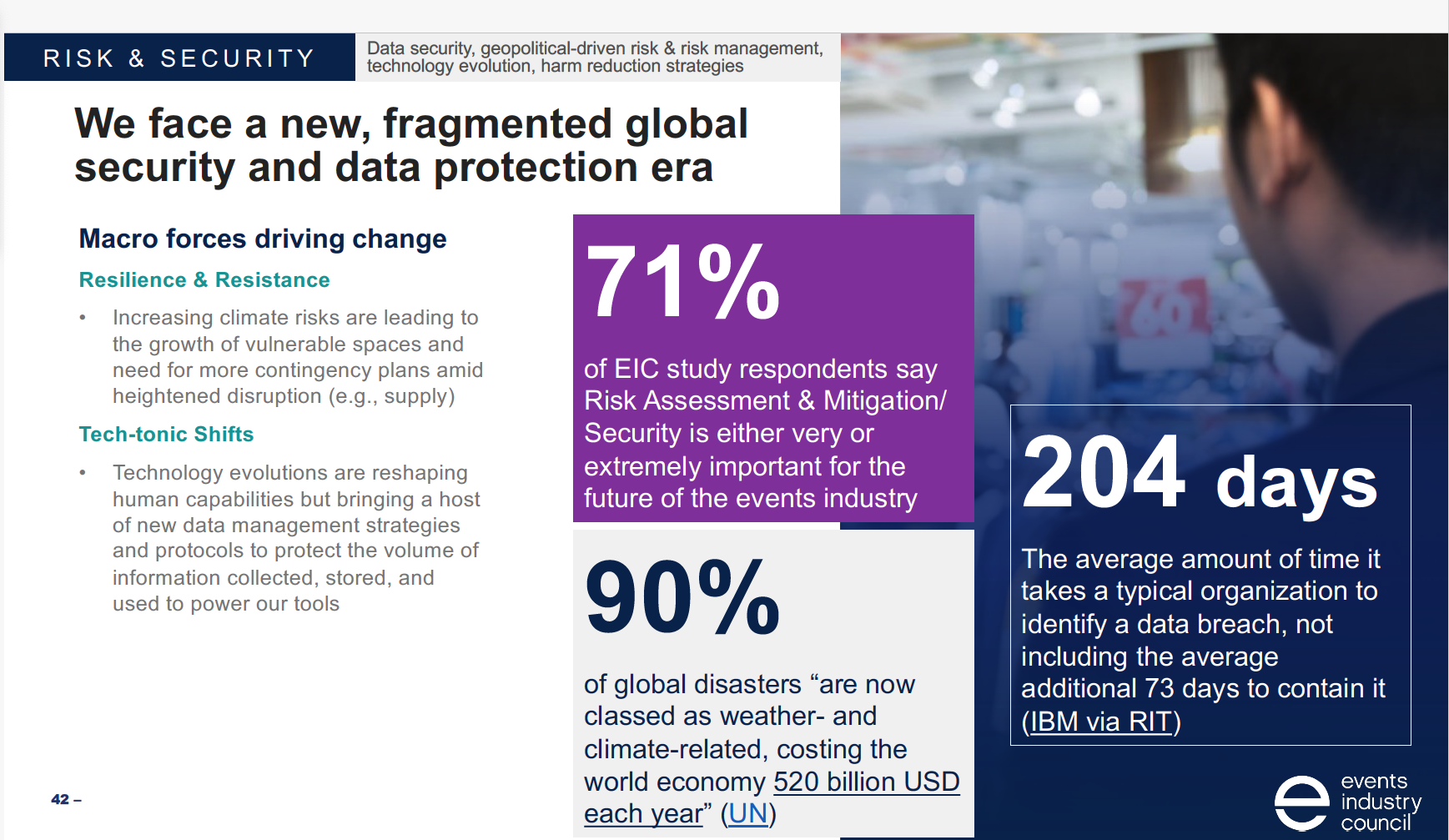
Yet, as highlighted in Destinations International’s 2025 DNEXT Futures Study and reinforced by the Events Industry Council’s (EIC) Futures Landscape Report on Risk, disruption is no longer episodic but structural. We are operating in what the EIC report describes as a “fragmented global security and data protection era” in which risk is persistent, interconnected and increasingly complex.
From our perspective at Destinations International, three defining realities are shaping the sector today.
First, risk has become multidimensional and deeply interconnected.
The EIC study makes clear that the future of travel and business events will be shaped not by a single category of disruption, but by the convergence of geopolitical instability, climate risk, cybersecurity threats and operational vulnerabilities. These forces do not operate in isolation. Climate-related disruptions, for example, are now linked to broader security concerns, while technological advancement introduces both efficiency gains and new data protection challenges.
For destinations, this means risk management can no longer be siloed. Instead, it must evolve into a comprehensive, integrated discipline that accounts for physical safety, digital security, environmental resilience and global instability simultaneously.
Second, complexity is becoming the defining operating condition.
As global systems fragment, destinations and event organisers are being forced to navigate increasingly inconsistent regulatory environments, security standards and travel requirements. Industry professionals are, in effect, becoming experts in multiple jurisdictions—managing compliance, safety and logistics across a rapidly shifting landscape.
This growing complexity has real implications. It increases costs, strains operational capacity and, importantly, can impact the traveller and attendee experience. In a sector built on seamless connection and hospitality, friction is a competitive disadvantage. At the same time, expectations around safety, transparency and preparedness are rising. Travellers and event participants are placing greater emphasis on trust—trust that destinations can deliver not only meaningful experiences, but also secure and reliable ones.
Third, resilience is no longer reactive, but strategic.
Historically, resilience in travel and tourism has been defined by recovery. Today, it is defined by readiness. The EIC findings point to a future where organizations must develop comprehensive risk management frameworks that address everything from venue safety and cybersecurity to climate-related disruptions and geopolitical instability. This is certainly the case as well for meeting and event planners and business events.
This aligns closely with DI’s DNEXT Futures Study, which emphasizes the need for scenario planning, crisis and crisis communications planning and response, adaptive leadership and cross-sector collaboration. Destinations play an increasingly important role and those that succeed will be the ones that anticipate disruption, rather than simply respond to it.
Importantly, this shift also elevates the role of advocacy and alignment. The lack of standardized global security frameworks, as noted in the EIC research, adds complexity and inefficiency across the system. This presents an opportunity – and a responsibility – for for industry organizations to help drive greater coordination, shared standards and collective action.
Despite these challenges, the outlook for travel and tourism remains strong. Demand for travel and in-person meetings and events continues to be driven by a fundamental human need for connection, discovery and shared experience. In fact, in a world marked by division and uncertainty, the role of travel as a connector of people and ideas has never been more important.
The destinations that will lead in this environment are those that embrace a broader definition of value, one that goes beyond visitation metrics to include resilience, sustainability, community impact and trust. They will invest in infrastructure and workforce development, integrate technology thoughtfully and prioritize safety and security as core components of the visitor experience.
They will also recognise that no destination operates in isolation. The challenges we face, whether geopolitical, environmental or technological, are global in nature and require coordinated responses. Collaboration across borders, sectors and stakeholders will be essential to navigating the road ahead.
At Destinations International, we remain confident in the future of our sector – not because the environment is stable, but because our industry has consistently demonstrated its ability to adapt and evolve. The current moment calls for leadership, innovation and a renewed commitment to resilience.
In a disrupted world, destinations that can deliver certainty, safety and meaningful connection will define the next era of global travel and tourism.