Editor’s Note: This article from EIC Member and Strategic Partner Hilton is part of the Events Industry Council’s ongoing Futures Landscape Series, exploring the forces shaping the global business events industry as identified in the EIC Futures Landscape Study 2025. This month, we focus on Talent and Workforce Development.
The Human Side of Workforce Development
 Technology is transforming how we work. Generational expectations are reshaping workplace culture. And across the global business events industry, organisations are navigating increasing pressure to attract, develop and retain talented professionals.
Yet amid this rapid evolution, one of the most important leadership skills remains fundamentally human: the ability to build trust.
According to the EIC Futures Landscape Study 2025, 75% of respondents identified Talent and Workforce Development as very or extremely important to the industry’s future. The research highlights growing concerns about leadership development, generational differences, skills gaps and the need for greater investment in people.
These challenges are prompting an important question: How can organisations create environments where professionals at every career stage feel supported, empowered and equipped to succeed?
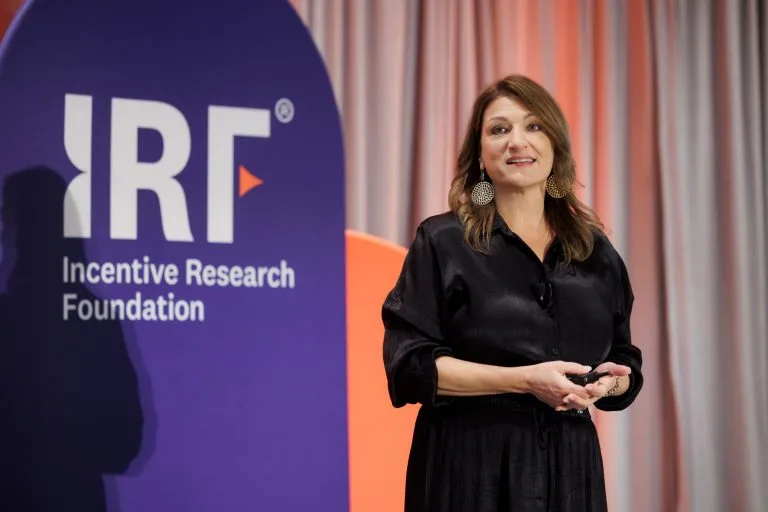
For Kim Napolitano, Executive Director, Global Industry Relations at Hilton, the answer begins with trust.
“Trust is at the heart of so much of what we do in travel and hospitality,” Napolitano said. “It’s B2B travel planners trusting the brands and suppliers they choose for their constituents. And for event professionals, it’s attendees trusting that the experience will be worth their time investment.”
But trust is equally important within the organisations and teams responsible for delivering those experiences. It shapes how colleagues collaborate, how emerging professionals develop confidence and how leaders guide their teams through change.

Why Trust Matters More Than Ever
Napolitano recently attended a Global Business Travel Association (GBTA) session featuring Harvard Business School professor Frances Frei and Anne Morriss, entrepreneur, leadership coach and founder of The Leadership Consortium.
Their discussion explored the relationship between trust and effective leadership, particularly during periods of significant change.
Passionate about developing the next generation of leaders, Napolitano saw a direct connection between their insights and the challenges facing the business events industry.
“As technology accelerates and expectations evolve, organisations are being asked to adapt at unprecedented speed. But successful adaptation requires more than new tools, processes or technical competencies. It requires people who feel confident contributing ideas, navigating uncertainty and taking responsibility for outcomes,” she said. “That confidence is built through trust.”
For an industry grounded in human connection, this is particularly relevant. Business events professionals work across complex networks of clients, suppliers, venues, destinations and partners. Their success depends not only on technical expertise but also on relationships, communication and the ability to collaborate effectively.
These same capabilities are essential to developing the industry’s future leaders.
The Trust Triangle: Three Essential Leadership Qualities
Frei and Morriss developed the Trust Triangle to illustrate three interconnected drivers of trust: authenticity, logic and empathy.
- Authenticity: People trust leaders who are genuine, transparent and comfortable showing up as themselves.
- Logic: Trust grows when individuals demonstrate sound judgment, competence and the ability to make thoughtful decisions.
- Empathy: People are more likely to trust those who demonstrate genuine care for their perspectives, experiences and wellbeing.
When all three qualities are present, trust strengthens. When one is missing, relationships can become vulnerable.
For business events leaders, the model offers a practical framework for supporting professionals across generations and career stages.
Authenticity helps create workplace cultures where people feel comfortable expressing ideas and asking questions. Logic reinforces the importance of professional knowledge, critical thinking and sound decision-making. Empathy allows leaders to recognise individual needs, aspirations and challenges.
Together, these qualities help create environments where learning, collaboration and innovation can thrive.
They are also increasingly important as organisations navigate changing workforce expectations and the integration of emerging technologies.
Five Ways Leaders Can Build Trust and Strengthen Their Teams
Drawing on the insights shared by Frei and Morriss, Napolitano identified five practical approaches that leaders can apply in their organisations.
- Get curious before getting judgmental.
Effective leaders seek to understand challenges before jumping to solutions. Asking thoughtful questions encourages open dialogue and helps uncover issues that might otherwise go unaddressed.
For emerging professionals, this approach creates opportunities to learn, contribute and develop problem-solving skills without fear of immediate judgment.
- Listen more than you speak.
Listening is one of the most powerful ways to demonstrate respect and build confidence.
Leaders who take time to understand different perspectives create stronger connections with their teams. Equally important is explaining the reasoning behind decisions so that individuals understand how their contributions connect to broader organisational goals.
The shift from an individual-centred to a team-centred leadership approach can help strengthen both engagement and performance.
- Make room for unexpected perspectives.
The best ideas do not always come from the most experienced person in the room.
Inviting contributions from professionals with different backgrounds, experiences and levels of seniority can lead to more creative solutions and better decisions.
This is particularly relevant to an industry navigating generational change. Creating opportunities for emerging professionals to contribute alongside established leaders supports knowledge sharing in both directions and helps build a more inclusive leadership pipeline.
- Give people a story they can believe in.
Change can create uncertainty, particularly when individuals are unsure how new technologies, organisational priorities or workplace expectations will affect their roles.
Effective leaders help people understand why change is necessary, how it connects to the organisation’s purpose and what opportunities it may create.
For younger professionals considering their long-term future in business events, that sense of purpose can be especially meaningful.
- Give people the power to move.
Trust is strengthened when individuals have the knowledge, resources and authority to make decisions.
Leaders who empower their teams create opportunities for professional growth while reducing unnecessary barriers to action.
Rather than requiring every decision to move through senior leadership, organisations can build confidence and capability by giving professionals greater ownership of their work.
This approach supports both organisational agility and individual career development.
Connecting Leadership to the Future of Talent
The themes explored by Hilton closely align with the findings of EIC’s Futures Landscape Study.
The research points to a convergence of challenges affecting the global workforce: technological disruption, generational differences, changing expectations around wellbeing and a growing need for continuous professional development.
It also underscores the importance of moving beyond short-term workforce solutions toward sustained investment in human capital.
Building trust is an important part of that investment.
For organisations, it means creating cultures where people feel valued, supported and encouraged to develop new capabilities. For experienced professionals, it means recognising their role as mentors and advocates for the next generation. And for those entering the industry, it means having opportunities to learn, contribute and envision a meaningful career.
These priorities are central to EIC’s Pathways initiative, which is focused on helping individuals discover opportunities within the business events industry and supporting their professional development throughout every stage of their careers.
By connecting career exploration, learning, mentorship and professional recognition, Pathways reflects the importance of building a workforce equipped with both the technical knowledge and human-centred skills needed for long-term success.
Trust, empathy, communication and collaboration are essential to that journey.
Investing in People Is Investing in Our Future
The business events industry has always been built on relationships. Its ability to bring people together, exchange ideas and create meaningful experiences depends on the expertise and commitment of the professionals who make those connections possible.
As the industry evolves, developing future-ready talent will require more than attracting new people into the workforce. It will require a sustained commitment to helping them grow, empowering them to lead and creating environments where they can thrive.
Hilton’s perspective offers a timely reminder that effective leadership is not simply about moving faster or managing change. It is about building the trust that allows people to move forward together.
And for an industry whose greatest strength is its people, that may be one of the most important investments we can make.