Editor’s Note: This article continues the Events Industry Council’s ongoing Futures Landscape Series, exploring the macro forces shaping the global business events industry, as identified in the EIC Futures Landscape Study 2025. Each month, we spotlight one of the 12 key forces influencing the industry’s evolution, sharing insights from EIC Members, Strategic Partners, Volunteer Leaders, CMP Fellows, and voices from across the global events ecosystem. This month, we focus on Mobility.
Global travel has not simply returned—it has fundamentally changed.
Today’s mobility landscape is defined by strong demand layered with persistent disruption, rising costs, geopolitical complexity, and uneven access. For the business events industry, mobility is no longer a question of recovery or volume, but of reliability, equity, and experience in a world where movement itself has become more fragile.
 The Futures Landscape Study 2025 identifies Mobility as one of the 12 critical forces shaping the future of business events. Influenced by protectionist policies, visa and documentation challenges, climate-related disruptions, labour shortages, and rapidly evolving transportation technologies, mobility now sits at the intersection of access, risk, sustainability, and global participation.
“Mobility can no longer be treated as a background operational issue,” one industry leader noted. “It directly affects who can attend, how they experience an event, and whether global knowledge exchange is truly possible.”
Access in an Uneven Landscape
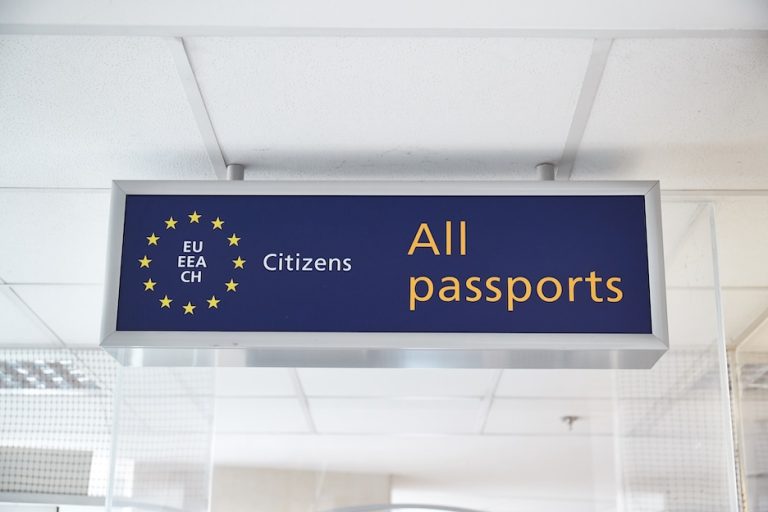
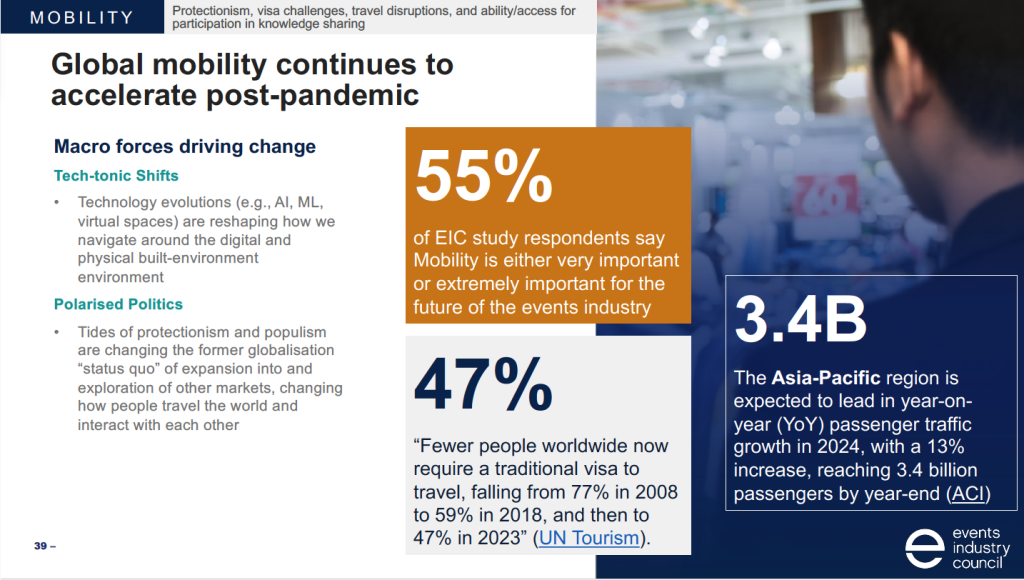
Despite sustained appetite for in-person connection, access to business events remains uneven. While fewer travellers worldwide now require traditional visas than in previous decades, documentation requirements, border controls, and geopolitical tensions continue to restrict participation across regions.
At the same time, rising travel costs, constrained air capacity, staffing shortages, and ongoing disruptions—from extreme weather to regional conflict—are reshaping how, when, and where people travel.
According to the study, just over half of respondents said mobility is very or extremely important to the future of the industry—reflecting both its essential role and the growing friction surrounding it.
“More people want to travel, but the system isn’t keeping pace,” said one U.S.-based events owner. “Air seats, hotel rooms, skilled staff—it’s all under pressure.”
From Movement to Experience
Respondents also expressed concern about the commoditisation of travel. As efficiency and volume increasingly dominate mobility systems, many fear a decline in service quality and human-centred design—particularly for business travellers navigating tight schedules and high expectations.
For event organisers, this raises a critical question: how can mobility support—not detract from—the overall event experience?
The study suggests future success will depend on designing seamless, multimodal journeys that minimise friction before and after the event. This includes stronger integration across air, rail, ground transport, and urban mobility options, as well as clearer communication and contingency planning.
“Mobility must evolve from a transaction into an experience,” one European respondent observed. “Otherwise, the value of attending in person begins to erode.”
Technology, Sustainability and the Road Ahead
Technological innovation continues to reshape mobility at pace. From real-time travel data and AI-enabled routing to the growth of Mobility-as-a-Service platforms, electric vehicles, and micromobility solutions, the way people move is becoming more personalised—and more complex.
At the same time, sustainability expectations are rising. Urbanisation, emissions targets, and environmental scrutiny are forcing destinations and organisers to balance efficiency with responsibility, while attendees increasingly weigh the environmental impact of travel decisions.
Looking ahead, the study anticipates continued growth in blended travel patterns, including the mainstreaming of bleisure (business + leisure), as professionals seek to maximise the value of long-distance trips amid tighter budgets and changing work norms.
Mobility as a Strategic Imperative
Ultimately, mobility is no longer just about logistics—it is about participation, relevance, and reach. Without thoughtful approaches to access and movement, events risk becoming less inclusive, less global, and less resilient.
As one Latin American CEO put it: “If we don’t address mobility challenges head-on, we risk limiting who gets to be in the room—and whose voices are heard.”
As the Futures Landscape Series continues, this month’s focus on mobility reinforces a central truth: the future of business events depends not only on where we gather, but on how easily—and equitably—we can get there.