Editor’s Note: This article continues the Events Industry Council’s ongoing Futures Landscape Series, exploring the macro forces shaping the global business events industry, as identified in the EIC Futures Landscape Study 2025. Each month, we spotlight one of the 12 key forces influencing the sector’s evolution, drawing on insights from EIC Members, Strategic Partners, Volunteer Leaders, CMP Fellows and other voices across the global events ecosystem. This month, we focus on Diversity, Equity and Inclusion (DEI).
Representation as a Growth Strategy
The global business events industry has always been built on bringing people together. Yet as societies become more diverse and interconnected, a critical question has gained urgency: who gets to be in the room—and whose voices are represented?
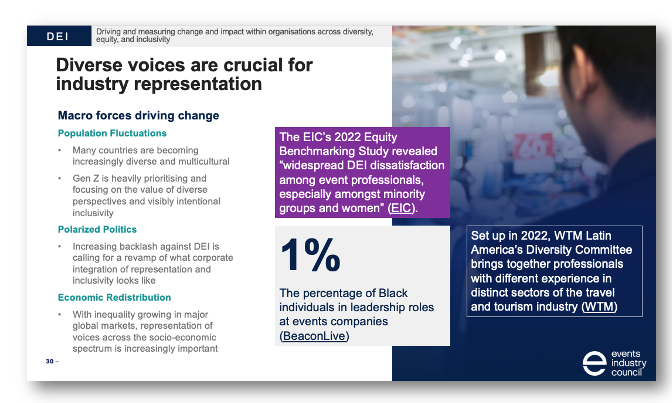 The Futures Landscape Study 2025 identifies Diversity, Equity and Inclusion as a key force shaping the industry’s future. Respondents emphasised that expanding representation—across gender, race, geography, culture, socioeconomic background and lived experience—is not only a social priority but a pathway to innovation, growth and stronger industry relevance.
At the same time, progress remains uneven. Research referenced in the study highlights persistent disparities in representation across leadership and decision-making roles in the events ecosystem. These gaps reinforce a broader industry challenge: translating commitment into meaningful structural change.
“DEI initiatives actively address barriers that may discourage or exclude individuals from fully participating in events,” said one North American education-sector leader who contributed to the study. “Removing those barriers creates a fairer and more equitable experience for everyone.”
A Global Conversation with Local Nuance
One of the defining insights from the research is that DEI cannot be approached through a single global lens. Cultural norms, historical contexts and societal dynamics vary widely across regions, meaning the path toward greater inclusion looks different from one market to another.
Respondents stressed the importance of balancing global ambition with local sensitivity—recognising that frameworks developed in one region may not always translate seamlessly elsewhere.
A European industry professional noted that conversations about inclusion can sometimes become overly Western-centric. “We need to think about DEI through both a ‘global north’ and ‘global south’ perspective,” they said. “When we bring more viewpoints into the conversation, we strengthen the dialogue.”
This complexity highlights the need for shared language and adaptable frameworks that allow organisations to pursue meaningful inclusion while respecting regional differences.
From Representation to Experience
In the events industry, DEI extends beyond workforce diversity or leadership representation. It also shapes the design of the event experience itself.
Inclusive event practices may include:
- Diverse speaker representation and programme design
- Multilingual access and cultural considerations
- Accessible venues and digital platforms
- Inclusive catering, scheduling and networking formats
- Removing financial or logistical barriers to participation
When thoughtfully integrated, these considerations expand participation and create environments where attendees feel welcomed, respected and able to contribute fully.
“Our industry is evolving rapidly, and we are seeing greater diversity across sectors,” said one transportation-sector executive involved in the study. “To move forward, we must embrace DEI as a core element of how we operate.”
The Tension Between Intention and Implementation
Despite widespread recognition of DEI’s importance, respondents consistently highlighted a key tension: implementation often lags behind aspiration.
Organisations may publicly commit to inclusion while struggling to embed it in decision-making, governance and operational practices. Others face uncertainty about how to measure progress or navigate politically polarised conversations around diversity initiatives.
In some regions, recent pushback against DEI programmes and terminology has introduced additional complexity, prompting organisations to reconsider how these efforts are framed and communicated. Yet many industry leaders emphasise that the underlying goals—expanding opportunity, broadening participation and ensuring events reflect the diversity of the communities they serve—remain essential to the long-term health and relevance of the global business events ecosystem.
Authenticity, respondents emphasised, is critical. Performative gestures can erode trust, while sustained, transparent efforts build credibility over time.
Preparing for a More Diverse Future
Looking ahead, demographic shifts and generational change are expected to reshape the events workforce and attendee base alike.
Younger professionals—particularly Gen Z—place high value on representation, equity and belonging in the organisations they choose to join and the events they attend. At the same time, global migration and population shifts are making societies more multicultural, creating both opportunity and responsibility for event organisers.
The Futures Landscape Study suggests that over the next five years, successful organisations will move beyond isolated initiatives toward integrated DEI strategies embedded in their culture and operations.
Key priorities may include:
- Embedding inclusion into leadership and governance structures
- Expanding mentorship and leadership pathways for underrepresented professionals
- Ensuring event design reflects diverse cultural perspectives
- Addressing bias in emerging technologies such as AI-enabled event planning tools
- Developing shared frameworks that allow for global alignment with regional flexibility
Inclusion as a Catalyst for Innovation
Ultimately, DEI is not only about fairness—it is about unlocking the full potential of the global events ecosystem.
When diverse perspectives are represented in programme design, leadership and audience participation, the result is richer dialogue, stronger innovation and more resilient organisations.
“DEI has to be a key element of our industry,” reflected one executive in the transportation sector. “It creates both social value and business value.”
As the Futures Landscape Series continues, this month’s focus on Diversity, Equity and Inclusion underscores a simple but powerful idea: the future of business events will be shaped not only by how we gather—but by who is invited to participate, contribute and lead.