 I feel like I’ve seen more risk for events in the past five years than in the previous 26 years of my career.
 Risk is not new. Events have always carried it. But two things are happening at once. We all know the level of unpredictability is increasing. But there is also another layer of slower, less visible risk that we are not talking about enough. And it is potentially more disruptive.
The Risk Everyone Is Managing
You wake up in the morning and decisions outside your control have reshaped your event overnight. A policy shift affects travel. A company cuts budgets. A global issue changes your audience’s priorities. Revenue and participation that felt solid a month ago are no longer reliable.
This is the risk everyone is talking about right now. It is table stakes. It requires a constant state of adjustment.
We are learning how to operate here. We build backup plans, monitor data closely, and stay in close communication with stakeholders.
But we have a blind spot.
The Risk Taking Shape Beneath the Surface
There is a broader shift happening, driven by the convergence of several macro forces.
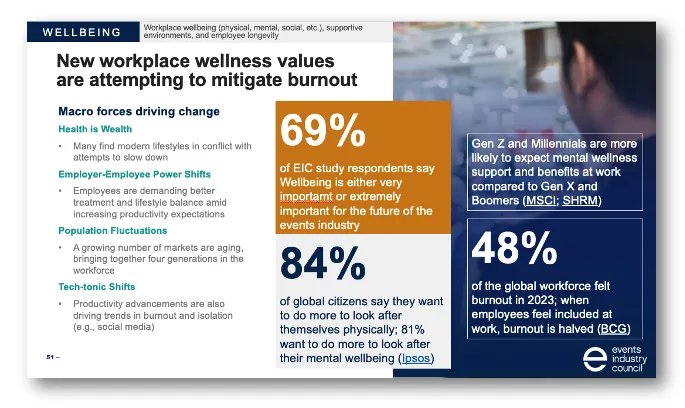
Demographic shifts are changing participation. In some sectors, experienced professionals are retiring faster than new ones are entering. That affects attendance, workforce pipelines, and long-term growth. At the same time, an aging population is creating new areas of demand, driving growth in some sectors and launching new ones.
Climate change is affecting events. Weather disrupts travel, impacts venues, and drives up food and beverage costs. It also raises expectations around sustainability and responsible planning.
Technology is accelerating change. Artificial intelligence is already changing how people learn, shop, and engage. As these tools become more embedded in daily life, we do not know what the future will look like.
Each of these forces is significant on its own. Together, they are compounding, and we are just starting to see the implications.
Why This Matters Now
In the short term, we see behaviour changes. Attendees are more selective. Organisations are more cautious. Expectations for value and safety are higher.
In the long term, the picture is less clear. That makes it harder to plan and easier to become reactive.
When you do not know how your audience will change, how your industry will be disrupted, or how external forces will reshape your event, it becomes harder to plan with confidence. It is also easier to fall into a reactive pattern, responding to what is happening instead of preparing for what might happen. If the world is shifting, our approach to planning must shift as well.

What to Do About It
Managing risk today requires working on parallel time horizons. In the near term (6 to 18 months), focus on readiness.
Build contingency into your budget. Identify high-probability, high-impact scenarios, from attendance drops to security incidents, and track early signals. Keep stakeholders informed so adjustments do not come as a surprise.
In the longer term (2 to 5 years), focus on preparation.
Look at what is happening today and imagine the future impacts. What does this mean for your audience, your industry, and your organization? How might the needs of your audience’s customers change? How will you ensure your event remains the most valuable offering in your space?
Then assess your organisation. What skills do you need to add? Where do you need new partners? How can you build flexibility into your model? This is not about trying to predict the future. It is about proactively preparing for whatever is coming your way.
The Importance of Our Events
Our audiences are navigating the same uncertainty. They come to events to make sense of what is happening and what to do next. They want guidance from experts. They want to process issues with peers.
That is where we come in. Our events are the place where they find that direction. The pace of change is accelerating. The risk is not only what happens tomorrow. It is what is building beneath the surface.
The organisations that succeed will be the ones that proactively plan for both.

Beth Surmont is an event strategist who works with associations to reimagine their events. With experience in both corporate and non-profit events, and as the Head of Strategy & Design for 360 Live Media, Beth is a leading designer of the next era of events.