
The 2026 Incentive Travel Index highlights workforce challenges, evolving skills and the growing value of human connections across the global business events industry.
As the global business events industry navigates changing workforce expectations, emerging technologies and an increasingly complex operating environment, new research from two Events Industry Council (EIC) member organisations reinforces a critical priority: investing in people.
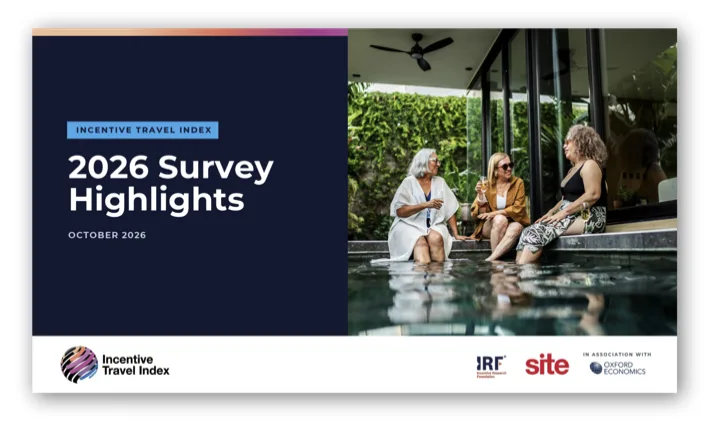
The 2026 Incentive Travel Index (ITI), developed by the Incentive Research Foundation (IRF) and the SITE Foundation in partnership with Oxford Economics, offers fresh insights into the forces shaping incentive travel. Now in its eighth year, the research draws on perspectives from 2,017 industry professionals across 83 countries.
While the report examines a broad range of industry trends, several findings speak directly to the future of talent, one of the central themes of EIC’s Futures Landscape series.
 Talent emerges as a long-term industry challenge
According to the ITI, 41.7% of respondents identify attracting and retaining talent as an important long-term challenge, compared with 25.2% who consider it a short-term concern.
The findings also highlight the potential loss of industry knowledge, identified by 26.4% as a long-term challenge, up from 19.7% in the short term.
Together, these findings point to an important distinction: while economic pressures and geopolitical uncertainty may demand immediate attention, the ability to attract, develop and retain skilled professionals will help determine the industry’s long-term resilience.
This aligns closely with EIC’s 2025 Futures Landscape Study, in which 75% of respondents identified Talent and Workforce Development as very or extremely important to the future of the global business events industry.
“Both reports point to the same priority: investing in people,” said Stephanie Harris, IRF President and EIC Board of Directors Chair. “Developing talent, preserving industry knowledge and strengthening human connections must go hand in hand with adopting new technologies to build a resilient industry.”
The Futures Landscape research explored the implications of demographic shifts, evolving career expectations, workforce wellbeing and the need for more intentional investment in professional development.
The new ITI findings add a valuable perspective from the incentive travel sector, reinforcing that workforce development is not simply a recruitment issue. It is also about retaining institutional knowledge, supporting career progression and equipping professionals with the skills needed to navigate change.
Technology is changing the skills landscape
The ITI also documents the accelerating integration of artificial intelligence into incentive travel operations.
More than six in ten respondents (60.8%) report using AI for three or more applications, while 22.9% use it for five or more. Applications range from content creation and destination research to programme design, supplier sourcing and budgeting.
Yet technology adoption does not automatically translate into competitive advantage. Only 24.4% of respondents agree that companies using AI are already outperforming competitors in designing more personalised, cost-effective and logistically optimised programmes.
For the industry’s talent agenda, the implications are significant.
As AI becomes more deeply embedded in everyday workflows, professionals will need opportunities to strengthen their digital capabilities while continuing to develop the creativity, critical thinking and relationship-building skills that distinguish exceptional event experiences.
The importance of these human capabilities is evident elsewhere in the research. When selecting destination management companies, 81.2% of buyers cite creativity and innovation as important factors, followed by reputation through word-of-mouth recommendations (79.5%) and demonstrable destination connections (75.2%).
The enduring value of human connection
One of the most compelling themes emerging from the ITI is the continued importance of trusted relationships and shared industry knowledge.
More than three-quarters of buyers (77.5%) say relationships and direct experience help them look beyond negative headlines to assess actual conditions in a destination.
Similarly, 62.2% rate recommendations from peers at industry associations as a very effective information source when considering destinations—outperforming digital channels.
These findings underscore the enduring value of professional communities, mentorship and knowledge-sharing, particularly as experienced professionals prepare the next generation of industry leaders.
They also reinforce an important message from EIC’s Futures Landscape research: the future of the industry depends not only on how quickly organisations adopt new technologies, but also on how effectively they develop, connect and support their people.

Building pathways for the future
The research provides additional context for EIC’s Pathways initiative, which is focused on strengthening connections to careers in the global business events industry and supporting professional growth at every stage.
By helping individuals discover career opportunities, connect with professional communities and access education and development resources, Pathways reflects a broader commitment to cultivating the workforce needed for the industry’s future.
The ITI’s findings also reinforce the value of education beyond the event profession itself. More than three-quarters of respondents (76.2%) agree that educating the next generation of corporate HR and finance leaders about the value of incentive travel would be a better industry investment than developing new destinations or improving hotels.
This speaks to the importance of building awareness, communicating the business value of events and developing advocates who understand their contribution to organisational performance.
A shared responsibility for the future of talent
The 2026 Incentive Travel Index illustrates the value of industry-led research in identifying both immediate challenges and longer-term priorities.
For EIC and its global network of member organisations, the findings strengthen the case for a collective approach to workforce development—one that combines research, education, professional connections and clearer pathways for career advancement.
As the industry looks ahead, investing in talent will be essential to sustaining innovation, preserving knowledge and ensuring that business events continue to deliver meaningful economic and social impact.
Explore the research and resources:
This article is part of EIC’s Futures Landscape series, exploring the trends, opportunities and challenges shaping the future of the global business events industry.