New research finds business events generated US$3.1 trillion in total business sales, contributed US$1.8 trillion to global GDP and supported 24.2 million jobs in 2025
WASHINGTON, D.C., U.S.A. (4 August 2026) — The Events Industry Council, in partnership with Oxford Economics, today released the full 2026 Global Economic Significance of Business Events Study, providing a comprehensive examination of the scale, reach and broader value of the global business events sector.
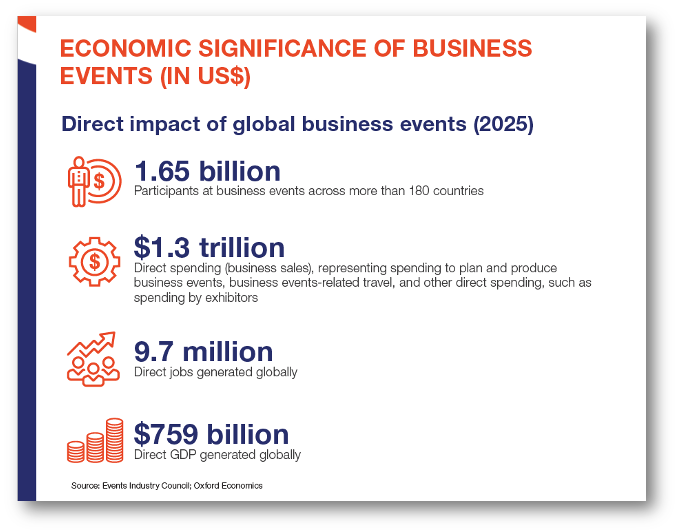
The study, supported by a wide array of stakeholders including Global Vision Sponsors MPI Foundation and PCMA, finds that business events brought together 1.65 billion participants across more than 180 countries during 2025 and generated US$1.3 trillion in direct spending. When indirect and induced activity is included, the sector supported US$3.1 trillion in total business sales, contributed US$1.8 trillion to global GDP and sustained 24.2 million jobs worldwide.
The full report offers an expanded analysis of global direct and indirect impacts, regional and country-level activity, workforce trends, trade shows, future growth forecast as well as insights related to the catalytic effects showcasing deeper more purpose driven elements of business events.
 The findings draw on a global survey of more than 1,600 event organisers, venues, destination marketing organisations and suppliers; country-level economic impact studies; third-party industry and government data, including exhibition-sector data from UFI, the Global Association of the Exhibition Industry; CEIR, and Oxford Economics’ global economic modelling. The analytical framework follows guidance developed by UN Tourism to support consistency across markets and event segments.
“Business events are a vital part of the infrastructure that supports economic growth, workforce development, innovation and global competitiveness,” said Amy Calvert, President and CEO of the Events Industry Council. “This report gives our industry credible, current evidence to demonstrate that value, while also helping us tell a more complete story about the knowledge, relationships, investment and long-term progress created through face-to-face engagement.”
“This study gives every part of our global business events community a shared foundation for action,” said Stephanie Harris, Chair of the Events Industry Council Board of Directors and President of the Incentive Research Foundation. “By bringing together credible data from markets around the world, it equips industry leaders to advocate with greater confidence, make stronger investment decisions and demonstrate how business events create lasting value for people, organisations and communities.”
A global economic engine
The report finds that business events directly supported:
- US$1.3 trillion in direct spending
- US$759 billion in direct GDP
- 9.7 million direct jobs
- 1.65 billion participants
Each US$1.00 in direct business event spending generated an additional US$1.37 in indirect and induced expenditures throughout the global economy.
North America led global direct spending with US$487.7 billion, representing 37.8% of the worldwide total. Asia generated US$352.8 billion, overtaking Western Europe, which accounted for US$328 billion.
Corporate and business events represented the largest share of direct spending, generating US$566 billion, followed by conventions, conferences and congresses at US$383.2 billion. Trade shows generated US$178.5 billion, while incentive events accounted for US$86.6 billion.
Growth expected through 2028
Oxford Economics forecasts direct business event spending will reach US$1.6 trillion in 2028, representing average annualised growth of 6.7% from 2025.
Direct employment is forecast to reach approximately 10.4 million jobs by 2028, within 4.1% of 2019 levels.
“The results demonstrate both the scale of the sector today and its importance to future global growth,” said Adam Sacks, President of Tourism Economics, an Oxford Economics company. “Business events support extensive economic activity across hospitality, transportation, venues, production, technology and professional services, while also enabling business relationships and knowledge exchange across industries.”
Trade shows create substantial global impact
The report also provides a focused analysis of trade shows, finding that these event brought together 318 million participants across more than 180 countries and generated US$179 billion in direct spending in 2025.
When direct, indirect and induced impacts are included, global trade shows supported:
- US$444 billion in total business sales
- US$256 billion in global GDP
- 4.3 million jobs
Value beyond direct spending
The full report examines the broader catalytic effects of business events, including new business opportunities, research collaborations, investment, professional development, knowledge transfer and industry innovation.
Among survey respondents:
- 70% said relationship-building through face-to-face interaction was the event outcome most difficult to replace.
- Organisations reported that 28% of revenue would be lost without attending or exhibiting at in-person events.
- Respondents estimated US$11 in incremental revenue for every US$1 invested in attending or exhibiting.
- Organisations attributed 22% of new customers to attending in-person events.
“This research belongs to the entire global business events community,” said Paul VanDeventer, President and CEO of MPI and Chair of the EIC Research and Advocacy Steering Committee. “We encourage our members, partners, destinations, event professionals and business leaders to use these findings in their own advocacy, investment and stakeholder conversations. Data gives us credibility, and a unified voice gives us momentum.”
The full report is available for purchase for US$395 in the EIC Store.
Later this month, EIC will release regional reports and supporting advocacy resources to help organisations translate the global findings into relevant stakeholder, policy and communications conversations.
The study was made possible through the leadership and support of its Global Visionary Sponsors MPI Foundation and PCMA, and Strategic Sponsors Brand USA, Caesars Entertainment, Choose Chicago, Destinations International, Freeman, Hilton, IACC, IMEX Group, Incentive Research Foundation, Javits Center, Los Angeles Tourism and Convention Board, Maritz, The mci Group, MGM Resorts International, Religious Conference Management Association (RCMA), Resorts World Las Vegas, Society of Independent Show Organisers, SITE Foundation, U.S. Travel Association and The Venetian Resort Las Vegas.
Notes:
The study defines a business event as a gathering of 10 or more participants for a minimum of four hours in a contracted venue. It includes conventions, conferences, congresses, trade shows, exhibitions, incentive events and corporate or business events.
The research included a global survey of more than 1,600 event organisers, venues, destination marketing organisations and suppliers; country-level economic impact studies; third-party industry and government data sources, including exhibition-sector data from UFI, the Global Association of the Exhibition Industry, CEIR, and economic modelling conducted by Oxford Economics. The conceptual framework is based on guidance developed by UN Tourism, enabling the research to bring together diverse national and sector data within a consistent global methodology.